
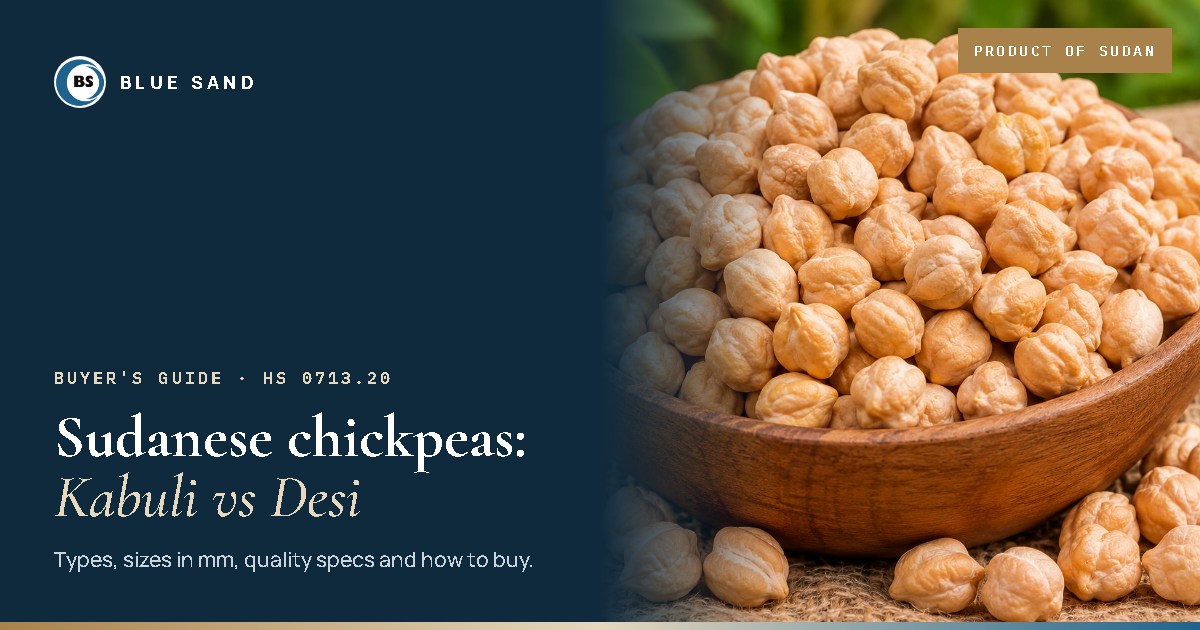
Chickpeas are one of the world’s most traded pulses, bought by packers, canners, hummus producers, flour millers and wholesalers. Sudan grows chickpeas as a winter crop, mainly under irrigation in the north of the country, and exports them through Port Sudan. This guide explains the two main types, how chickpeas are sized and graded, and what to put in your specification.
Kabuli and Desi: the two main types
Kabuli chickpeas are large, round and cream-coloured, with a thin seed coat and a mild flavour. They are the chickpeas most buyers know: used for hummus, canning, salads, ready meals and retail packs.
Desi chickpeas are smaller and darker, with a thicker, rougher seed coat. They are mostly split and polished into chana dal or milled into gram flour (besan), and are popular in South Asian markets.
Tell your supplier which type you need and the end use, because it decides the size and cleaning standard of your lot.
Sizes: why millimetres matter
Kabuli chickpeas are graded by size, measured as the diameter of the seed in millimetres. Larger, uniform sizes command higher prices and suit retail packs and canning, while smaller sizes suit hummus, flour and processing.
Our Sudanese chickpeas are offered in sizes from 7 to 12 mm. Agree the size range in your contract, along with the tolerance for seeds outside it.
The values buyers specify
- Type and size: Kabuli or Desi, size range in mm.
- Moisture: we offer 11%–12%. Lower moisture protects quality in storage and transit.
- Foreign matter: stones, dust, straw and other seeds removed during cleaning.
- Damaged and split seeds: broken, split, shrivelled and insect-damaged seeds, each with an agreed maximum.
- Colour: uniform colour matters for retail packs and canning.
- Food safety: pesticide residue and other tests required by your market. Confirm the current rules with your customs broker and agree any lab analysis before shipment.
All values should be written into the contract and confirmed by lot analysis before the goods ship.
Uses for Sudanese chickpeas
- Hummus and spreads
- Canning and ready meals
- Flour: gram flour for bakery, snacks and gluten-free products
- Retail packs and wholesale
Packing and container loads
Chickpeas are usually packed in PP bags, commonly 25 kg or 50 kg, and loaded into 20 ft or 40 ft containers. Ask your supplier for the exact quantity per container for your order and bag size.
Documents that travel with your chickpeas
- Certificate of Origin
- Phytosanitary Certificate
- Fumigation Certificate
- Commercial invoice, packing list and Bill of Lading
Our guide to export documents from Sudan explains each one.
How to order
- Send your specification: type, size range, moisture, quantity per shipment and per year, destination port.
- Approve a sample before you commit to a bulk order.
- Agree terms: FOB Port Sudan, or CIF to your destination port.
- Shipment: the lot is cleaned, size-graded, bagged, inspected and loaded at Port Sudan.
- Documents to you for customs clearance at destination.
Chickpea specification at a glance
| Parameter | Blue Sand offer |
|---|---|
| HS code | 0713.20 |
| Types | Kabuli / Desi |
| Size | 7–12 mm |
| Moisture | 11%–12% |
| Packing | PP bags |
| Terms | FOB Port Sudan, CIF on request |
Typical values; confirmed per contract against lot analysis.
Ready to source Sudanese chickpeas?
Send us your type, size, quantity and destination port, and our export team will reply with pricing, lead time and sample availability. See our chickpeas page, download the catalogue or request a quote.